
Continuation bias is often described as a pilot decision-making problem. In litigation, that framing is usually too narrow. The more useful question is this: when an approach became unstable, what operational safeguards were supposed to interrupt the chain, and why did they fail?
The broader framework for how decision chains form and degrade, before an approach ever becomes unstable, is covered in our core analysis of pilot decision-making in aviation accidents.
Operational Analysis
From a Chief Pilot's standpoint, continuation bias is rarely a single bad choice made at the threshold. It develops earlier, often well before the aircraft crosses the runway environment. The crew has invested time, fuel, workload, and expectation into completing the arrival. Weather may be marginal but legal. The runway may be available but operationally unforgiving. ATC sequencing may favor continuation. Passengers, schedule commitments, or repositioning demands may be in the background, even when nobody says them out loud.
That is how continuation bias works in real operations. It is not simply a conscious refusal to go around. It is a progressive narrowing of perceived options. Each small deviation becomes easier to tolerate because the flight is still, in some sense, recoverable. Slightly high on profile. Slightly fast. A delayed descent configuration. A late landing checklist. A tailwind component still within reported limits. An approach briefing that acknowledged threats without building a practical intervention plan.
The erosion of margin is usually incremental. The first meaningful question is not whether the landing was technically possible. It is whether the operation remained inside the operator's intended safety gate. Stabilized approach criteria exist for that reason. They are not administrative preferences. They are barriers designed to force a decision before a crew runs out of runway, time, or mental bandwidth.
In many runway excursion events, the unstable approach is the visible outcome, but not the full cause. By the time the aircraft crosses the threshold fast, floats long, touches down beyond target, or lands without effective stopping margin, multiple safeguards have already failed.
Decision Chain: Where Intervention Fails
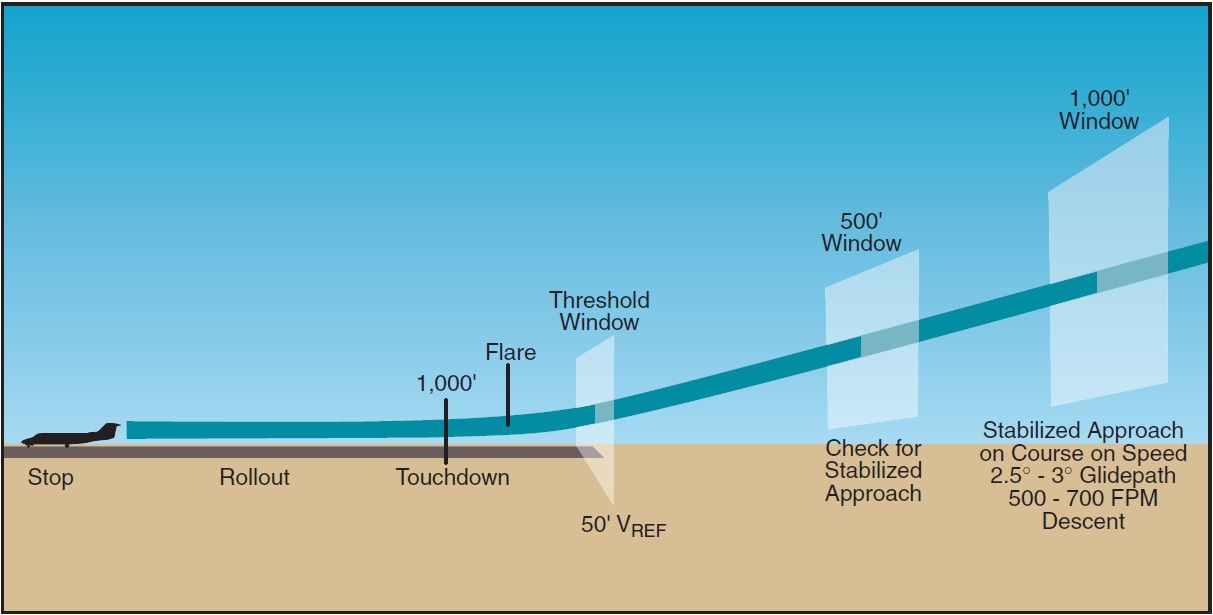
In practice, continuation bias should be analyzed as a sequence of missed intervention points.
- Pre-Arrival Planning: Was the runway length appropriate for actual conditions, not just book legality? Was contaminated runway data used properly? Was there an expectation bias created by prior successful operations into the same airport? Did the crew identify a no-fault go-around strategy if parameters were not met?
- Briefing Quality: Many approach briefings are technically complete but operationally weak. A crew may review minima, frequencies, and missed approach instructions, yet fail to define what will trigger discontinuation. If the briefing does not convert threats into observable no-go criteria, it does little to stop continuation bias.
- Stabilized Approach Gate: This is often where assumptions break down under scrutiny. Operators may publish stable approach standards, but the real question is whether those standards were specific, trained, monitored, and enforced. If an SOP says an approach must be stable by 1,000 feet IMC or 500 feet VMC, what happened when it was not? Was go-around compliance expected in practice, or was informal normalization allowed to replace policy?
- Crew Challenge and Response: Did the non-flying pilot call deviations clearly? Did cockpit authority gradient inhibit intervention? Was there a culture in which calling for a go-around was operationally routine, or one in which it was perceived as disruptive, embarrassing, or commercially undesirable?
- Touchdown Zone Commitment: Once the aircraft crosses the threshold high, fast, or floating, stopping performance becomes a real-time margin problem. A late touchdown on a wet or contaminated runway is not merely a landing technique issue. It is often the final manifestation of an earlier refusal, by crew or system, to reset the operation while options remained open.
Legal Analysis

For aviation attorneys, continuation bias matters because it tends to be oversimplified into pilot error. That may be part of the case, but it is often an incomplete causation model.
From an operational standpoint, this is where analysis typically begins: what defenses were designed to catch the unstable approach before runway margin became unrecoverable? If the answer is "the crew should have gone around," that is only the surface layer. The next level is whether the operator built an environment in which that decision was clearly defined, consistently trained, and organizationally protected.
- SOP Design: Were stable approach criteria objective or vague? Did they account for runway condition, tailwind, crossing restrictions, visual transition workload, or special airport factors? A weak SOP can create apparent compliance while still permitting unsafe continuation.
- Training Adequacy: Was go-around decision-making trained as a normal operational tool, or treated as an exception? In many cases, crews are trained extensively on conducting approaches and comparatively less on abandoning them early and decisively. That imbalance matters when evaluating foreseeability and operational control.
- Organizational Pressure: Pressure does not need to be explicit to be operationally significant. Reputational pressure, schedule pressure, customer expectations, fuel sensitivity, management emphasis on completion rates, or informal attitudes toward go-arounds can all narrow crew discretion. These influences are frequently denied in abstract policy language but visible in line behavior, event data, and crew testimony.
- Oversight and Data Use: If flight operations quality assurance, line checks, ASAP reporting, or internal audit data showed recurring unstable approach acceptance, long landings, or weak go-around compliance, the operator's notice becomes highly relevant. A runway excursion may look isolated in the event sequence while actually reflecting a known pattern.
- Airport and Performance Context: A short, wet, downhill, or contaminated runway changes the significance of seemingly modest deviations. Causation analysis must connect the operational geometry of the arrival to the aircraft's actual stopping margin. In litigation, this is often where generalized assumptions fail.
This is why causation is often misunderstood. The excursion itself is not the beginning of the event. Neither is the flare. In many cases, the actionable breakdown begins with an accepted approach setup that left no room for ordinary variation. That distinction often determines whether a case is analyzed as isolated pilot error or as a broader operational failure visible only after closer evaluation.
Closing
Continuation bias in aviation is best understood as a safeguard failure problem, not just a decision defect. The unstable approach, the long touchdown, and the runway excursion are often downstream effects of earlier normalization, weaker-than-advertised SOP barriers, and operational pressures that reduced the crew's willingness to discontinue.
For attorneys evaluating causation and liability, the central issue is not simply why the crew continued. It is why the operation allowed continuation to become the path of least resistance. That distinction often determines whether a case is analyzed as isolated pilot error or as a broader operational failure visible only after closer evaluation.
Need Aviation Expert Analysis?
If you are evaluating an aviation matter involving continuation bias, unstable approaches, runway excursions, or operational liability, AeroVerdict provides expert aviation analysis for attorneys and legal teams.
Request an Expert Case Review
About the Author
Kevin Alvarez
Kevin Alvarez is an ATP-rated Chief Pilot and aviation expert witness with experience in corporate aviation operations, pilot decision-making, FAA compliance, and aviation accident analysis. Through AeroVerdict, he provides expert witness and consulting services for attorneys and legal teams.
Full Bio