
Corporate aviation safety is a system, not an individual attribute. A well-run corporate flight department manages risk through structured training programs, standardized operating procedures, formal safety oversight, maintenance controls, and an organizational culture that supports conservative decision-making. When those systems are strong, they reduce dependence on individual improvisation and protect against the kinds of cumulative operational failures that lead to accidents.
When those systems are weak, or when compliance is treated as a documentation exercise rather than an operational reality, the risk environment shifts. That shift is not always visible in a single flight or a single crew action. It often emerges only when an accident occurs and investigators begin examining the broader operational context behind the event.
For attorneys, that context is frequently where the most significant liability questions lie. Accident causation in corporate aviation often reflects not only what a pilot did or failed to do, but what the organization required, permitted, monitored, and failed to correct over time. The relationship between organizational risk management and accident causation is also examined in our analysis of how aviation accidents actually happen.
The Role of Standard Operating Procedures
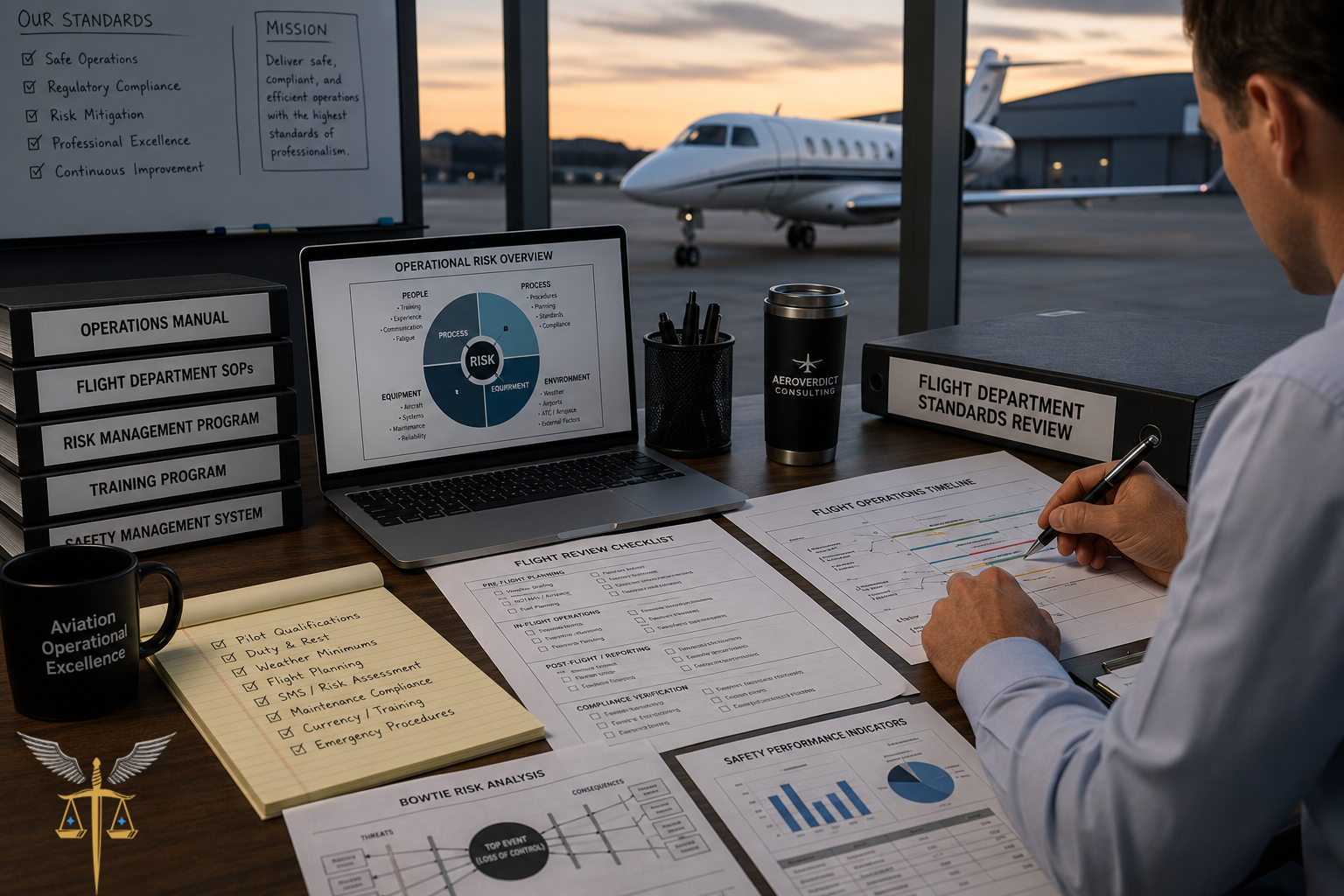
Standard operating procedures are the backbone of consistent safety performance in corporate aviation. A well-designed SOP establishes clear behavioral expectations for flight planning, dispatch, preflight preparation, approach management, abnormal procedures, and go/no-go decision-making. When procedures are well-constructed and actually followed, they provide a repeatable safety margin that does not depend on any single crew member's judgment in isolation.
The weaknesses in SOPs are often more significant than their gaps on paper. An organization may have a procedurally complete operations manual while still tolerating informal deviations in line operations. When checklist discipline is inconsistent, stabilized approach criteria are treated as advisory, or crew authority structures suppress legitimate operational challenges, the written standard becomes disconnected from actual practice.
In litigation involving corporate aviation events, operations manuals, training records, and crew qualification documentation are frequently examined to establish what the organization expected of its crews — and whether those expectations were enforced in practice. This type of analysis is central to evaluating FAA compliance and operational standards in the context of safety management.
Training Programs and Crew Proficiency
Training quality is a fundamental determinant of crew performance in demanding conditions. In corporate aviation, training programs vary significantly across operators. Some departments invest in simulator-based recurrent training that closely mirrors the aircraft, routes, and operational scenarios the crew will actually encounter. Others satisfy minimum regulatory requirements without developing the depth of scenario-based experience that builds genuine operational judgment.
Proficiency gaps often become visible in accident investigations. A crew may have been current by FAA standards while lacking the procedural fluency, automation management skill, or decision-making discipline needed for the specific demands of a complex flight. In those cases, training adequacy, not just training currency, becomes a key issue in evaluating causation and organizational responsibility.
This is directly relevant to human factors analysis in aviation accidents, where training history, recency, and program quality all bear on whether a crew's performance reflected an isolated lapse or a foreseeable product of inadequate preparation.
Safety Management Systems and Organizational Oversight
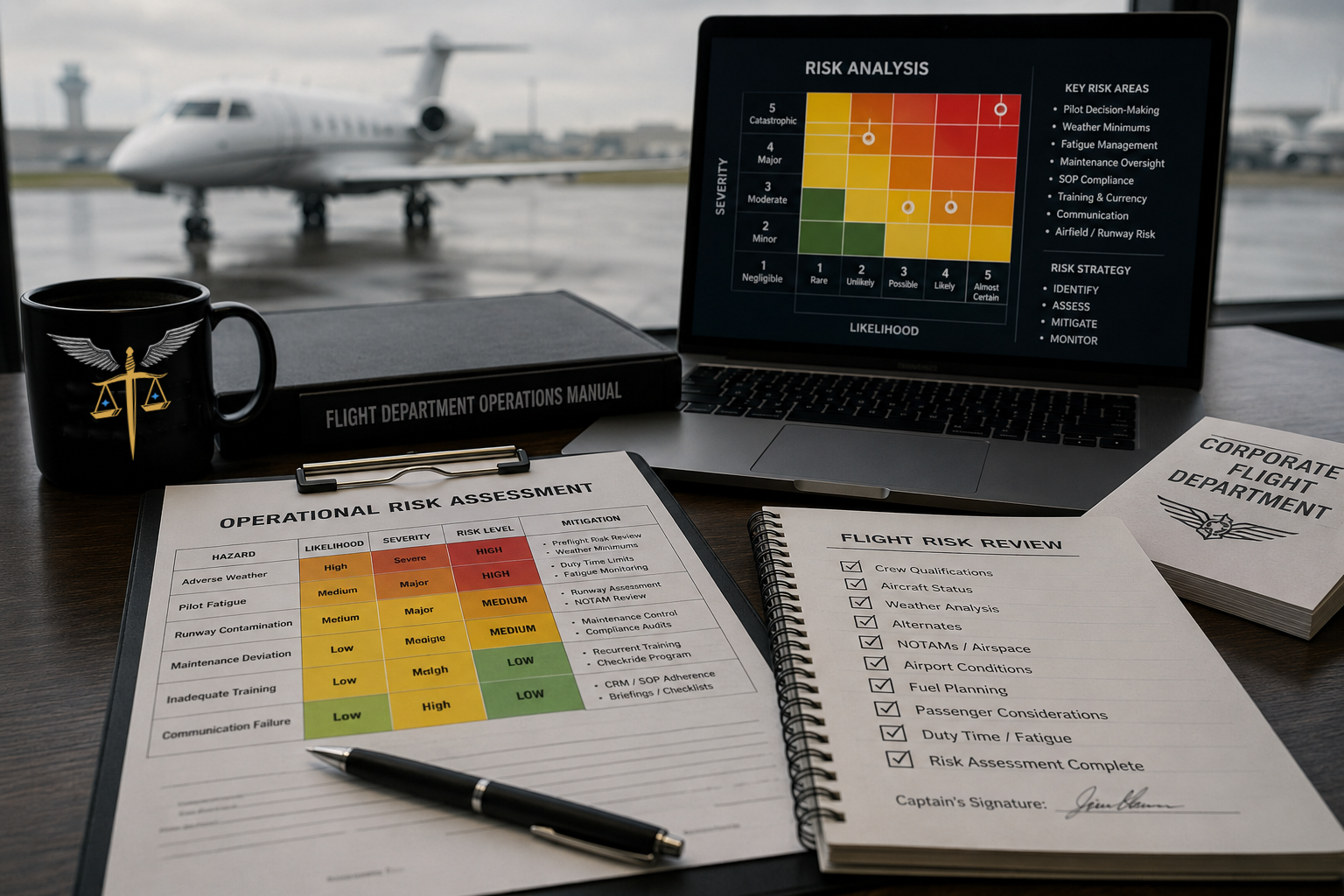
A formal Safety Management System creates a structured mechanism for identifying operational hazards, tracking leading indicators, and managing risk proactively rather than reactively. In corporate aviation, SMS programs may include flight data monitoring, ASAP or voluntary reporting systems, line observation programs, safety review committees, and periodic audits of operational procedures.
The presence or absence of an SMS, and more importantly whether it was functional in practice, can be highly significant in accident investigation and litigation. An organization with flight data monitoring capability that showed recurring unstable approach acceptance, long landings, or other risk indicators, and failed to act on that data, has a different liability profile than one encountering a wholly unexpected event.
This is one reason that internal safety data, safety reports, and management communications are often examined in detail during accident litigation. For attorneys evaluating corporate aviation matters, understanding whether the flight department had meaningful safety oversight, and whether it used the information available to it, is often central to the case.
Organizational Pressure and Safety Culture
Organizational pressure is one of the most difficult factors to evaluate in aviation accident analysis because it rarely appears explicitly in written communications. Schedule pressure, completion rate expectations, passenger preferences, management attitudes toward go-arounds or diversions, and the informal signals sent by leadership all shape the operational culture in which crews make decisions.
When safety culture supports conservative decision-making (when crews know that a go-around, diversion, or delay will be accepted without negative consequences) the operational environment is fundamentally safer. When that culture is absent, when crews perceive that conservative choices are second-guessed or that completions are valued over caution, the invisible pressure on decision-making is real even if it is never stated directly.
These dynamics are particularly relevant in continuation bias analysis and in evaluating why an unstable approach was not discontinued. The organizational environment surrounding a flight often helps explain choices that would otherwise appear difficult to rationalize.
Maintenance, Dispatch, and Support Systems
Corporate aviation safety also depends on the quality of maintenance oversight and dispatch support. Flight departments that maintain rigorous maintenance records, manage minimum equipment list items carefully, and coordinate effectively with maintenance personnel before and during trips reduce the likelihood that aircraft systems issues will become operational surprises.
Dispatch support (including pre-departure weather analysis, NOTAM briefings, performance planning, and fuel coordination) provides another operational safety layer. Departments that invest in structured dispatch processes give their crews better situational awareness before departure, which reduces the decision-making burden in the air. These systems are part of the broader operational context that expert review examines in aviation accident investigation.
Conclusion
Corporate aviation safety is the product of many interconnected systems: training programs, SOPs, crew oversight, safety management, maintenance controls, dispatch support, and an organizational culture that genuinely supports conservative decision-making. When those systems are strong, they protect against the cumulative operational failures that produce accidents. When they are weak, the risk is often systemic rather than individual.
For attorneys evaluating corporate aviation matters, understanding how these systems function, and how their failures contribute to accident causation, is essential to building a complete and credible analysis. An experienced aviation expert witness can help connect the operational record to the legal questions that matter most in litigation.
Need Aviation Expert Analysis?
If you are evaluating a corporate aviation matter involving flight department risk management, safety culture, pilot decision-making, or accident causation, AeroVerdict provides expert aviation analysis for attorneys and legal teams.
Request an Expert Case Review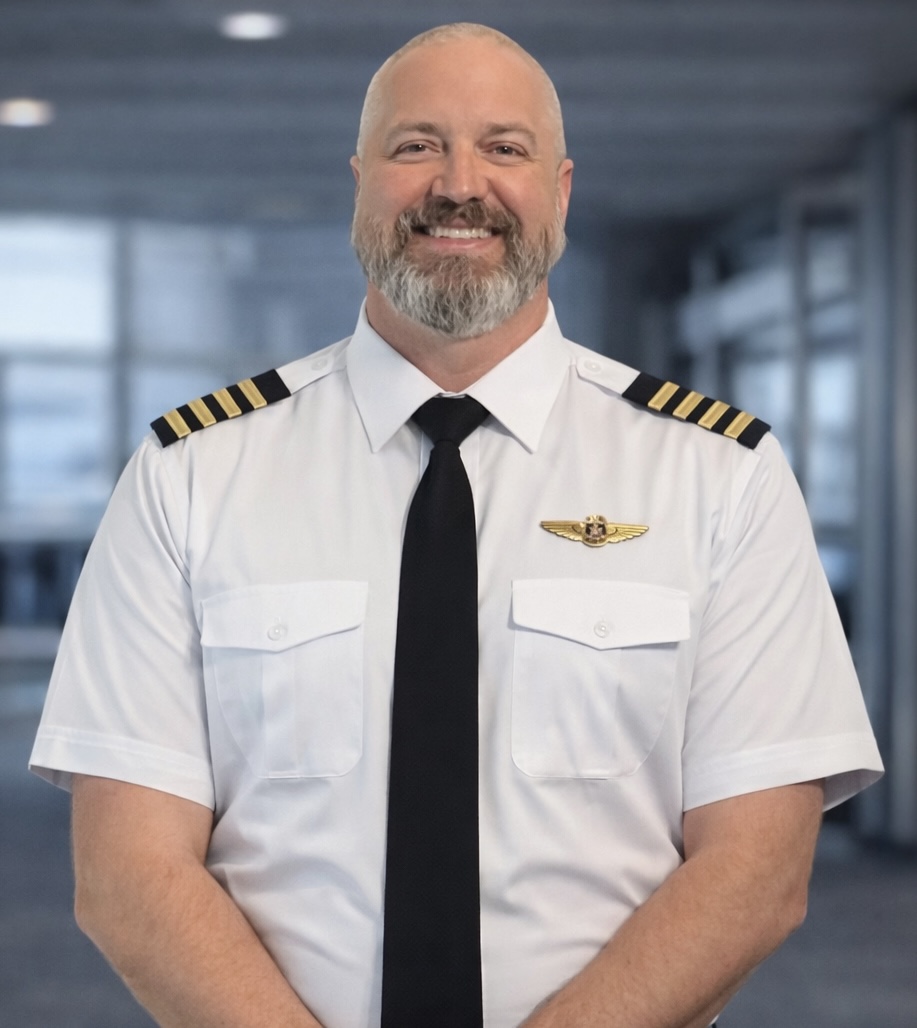
About the Author
Kevin Alvarez
Kevin Alvarez is an ATP-rated Chief Pilot and aviation expert witness with experience in corporate aviation operations, pilot decision-making, FAA compliance, and aviation accident analysis. Through AeroVerdict, he provides expert witness and consulting services for attorneys and legal teams.
Full Bio