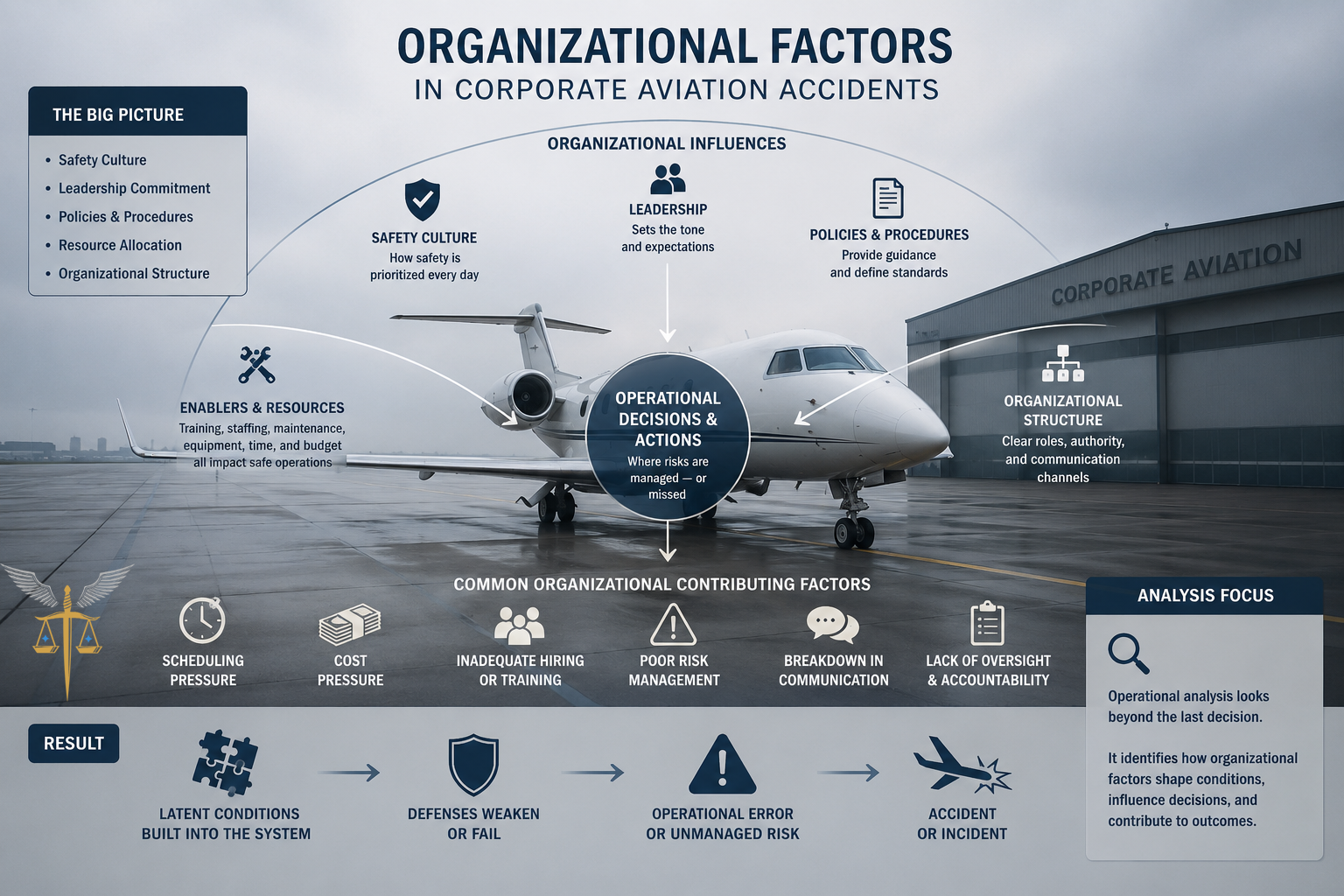
When a corporate aircraft accident occurs, the causal chain rarely begins on the day of the flight. In most corporate aviation accidents, the decisions that created the conditions for the accident were made weeks, months, or years earlier: inside the flight department itself. For aviation attorneys, understanding how organizational decisions translate into legal liability is the foundation of a defensible case theory.
Corporate flight departments operating under 14 CFR Part 91 exist in a regulatory environment that grants significant operational discretion. That discretion is not unlimited, and when exercised poorly (in hiring, training, scheduling, maintenance oversight, or safety policy) it creates measurable liability exposure. Attorneys who understand where that exposure lives before discovery begins are in a fundamentally different position than those who encounter it after depositions are scheduled.
The Corporate Flight Department as an Operational System
A corporate flight department is not simply a group of pilots. It is an organizational system with its own structure, culture, decision-making hierarchy, and operational norms. In the context of aviation accident litigation, that system is the subject of analysis: not just the final crew actions recorded in the last minutes of flight data.
Organizational Structure and Oversight
Most corporate flight departments are structured around a Director of Aviation or Chief Pilot who is accountable for operational standards, crew qualification, scheduling, and safety oversight. The adequacy of that structure, and the degree to which it is actually exercised, is a central question in litigation involving corporate aviation accidents.
When a flight department lacks clear lines of authority, operates without written standard operating procedures, or functions without meaningful safety oversight, those gaps are discoverable. They represent deviations from accepted industry practice, and they form the operational context in which individual crew errors occur.
The Role of the Operating Company
In corporate aviation, the aircraft operator and the employer of the crew are typically the same entity or closely related entities. This creates respondeat superior exposure that attorneys handling corporate aviation cases must map early. Liability does not attach only to the pilots: it flows through the organizational decisions made by the flight department and, in many cases, by non-aviation management who direct flight operations without aviation expertise.
When Organizational Decisions Precede Operational Failures
The phrase "the accident is rarely the first time the flight department made a decision it should not have" reflects a consistent finding in corporate aviation accident investigation. The NTSB's probable cause determinations in corporate aviation accidents frequently identify organizational factors, not just flight crew error, as contributing causes.
Systemic Patterns That Precede Accidents
Expert analysis of corporate aviation accidents regularly surfaces patterns that predate the accident by months or years:
- Relaxed currency and recency standards: Pilots operating without required simulator training, proficiency checks administered internally without objective standards, or crews cleared for operations they were not current to perform.
- Inadequate crew pairing practices: Scheduling patterns that consistently pair two pilots who lack complementary experience, or that assign newer crews to higher-risk routes or weather scenarios without supervision.
- Pressure to complete trips: Documented or demonstrable organizational pressure on flight crews to complete trips regardless of weather, crew rest status, or aircraft serviceability. This pressure is rarely explicit; it lives in operational norms, performance reviews, and the professional consequences of cancellations.
- Deferred maintenance and MEL abuse: Patterns of deferred maintenance items or minimum equipment list (MEL) extensions that individually appear routine but cumulatively reflect a maintenance culture that subordinates airworthiness to schedule.
- Absence of a functioning Safety Management System: A Safety Management System (SMS) is not required for Part 91 operators, but its absence, particularly in larger flight departments, is relevant evidence of organizational safety posture. Flight departments that operate without formal hazard identification, risk assessment, or safety reporting processes cannot demonstrate that they exercised appropriate oversight of the risks their operations created.
What Discovery Should Target in Corporate Aviation Cases
Attorneys entering discovery in a corporate aviation accident case should treat the flight department itself as the primary discovery target, not merely the crew personnel files. The documents that reveal organizational decision-making are not always in the flight department's own files: they are often in human resources, finance, legal, and executive correspondence.
Key Document Categories
An experienced aviation expert witness can help attorneys identify and interpret the following categories of documents, which are routinely relevant in corporate aviation accident litigation:
- Operations manuals and revisions: The current version of the flight department's operations manual is a starting point. Revision histories reveal when standards changed, what prompted changes, and whether changes were made reactively in response to incidents or proactively as part of safety management.
- Training records and check airman documentation: Training records reveal whether proficiency standards were applied consistently and whether required training was completed on schedule. Check airman qualifications and training records reveal whether the flight department administered training internally or used qualified third-party programs.
- Scheduling and duty time records: Part 91 does not impose FAR 117 rest requirements that apply to Part 121 operators, but internal flight department policies may impose limits. Scheduling records reveal whether those limits were respected and whether crews were operating within the fatigue parameters the flight department represented as its standard.
- Maintenance records and MEL logs: Deferred items, open discrepancies, and MEL extension patterns reveal maintenance culture and airworthiness risk posture over time, not just on the accident day.
- Safety reports and incident records: If the flight department operated a safety reporting program, those records are discoverable. Near-misses, crew-reported concerns, and safety observation logs reveal what the flight department knew, when it knew it, and what it did in response.
- Communications between non-aviation management and flight operations: Emails, calendar entries, and meeting records that reveal how non-aviation executives interacted with flight operations are among the most revealing documents in corporate aviation litigation. Pressure to complete trips, decisions made without pilot input, and scheduling driven by business needs rather than operational safety are frequently documented in corporate communications.
The Expert Witness Role in Corporate Flight Department Analysis
An aviation expert witness in a corporate aviation case performs a fundamentally different analysis than an expert focused solely on flight crew actions. The operational analysis examines the flight department as a system: its standards, culture, decision-making processes, and the degree to which those factors created or contributed to the conditions that produced the accident.
That analysis requires a working understanding of how corporate flight departments are structured and operated in practice, not just what regulations require. An expert who has operated within corporate aviation, not merely studied it, brings operational context that is difficult to replicate from academic or regulatory sources alone. For more on what this role entails, see What Is an Aviation Expert Witness and How Aviation Accident Investigations Work.
The expert's role in corporate aviation cases often includes:
- Assessing whether flight department policies and practices met accepted industry standards for operations of comparable scope and complexity
- Identifying the organizational decisions that created the operational context for the accident
- Evaluating pilot decision-making within the organizational and cultural framework the flight department created
- Analyzing human factors contributions (fatigue, crew resource management, normalization of deviance) as products of organizational practice, not just individual behavior
- Providing technically grounded opinions on whether the flight department's maintenance, training, and operational standards were adequate
Part 91 vs. Part 135: Why the Regulatory Framework Matters
Some corporate flight operations hold Part 135 certificates and operate charter services in addition to or instead of pure Part 91 operations. The regulatory obligations differ substantially between the two frameworks, and the applicable standard of care in litigation differs accordingly.
Part 135 operators are subject to more prescriptive requirements covering crew qualifications, training programs, rest limitations, maintenance programs, and operational control. When a Part 135 operator fails to meet those requirements, or meets them on paper while violating their substance in practice, that regulatory failure is directly relevant to liability analysis. For a detailed breakdown, see the AeroVerdict article on corporate aviation safety and flight department risk management.
Part 91 operators are not subject to the same prescriptive regulatory framework, but that does not mean the applicable standard of care is undefined. Industry standards, manufacturer guidelines, and accepted corporate aviation practice establish a baseline against which Part 91 flight department operations are measured in litigation. The absence of regulatory prescription does not insulate a Part 91 operator from liability when its operational practices fell below what a reasonable flight department would have done.
Conclusion
Corporate aviation accidents are not attributable solely to the actions of the crew on the accident flight. In a significant proportion of cases, the accident reflects an accumulation of organizational decisions (in hiring, training, scheduling, maintenance, and safety oversight) that created conditions the crew could not recover from. Identifying and articulating those decisions is the foundation of a complete causation and liability analysis in corporate aviation litigation.
Attorneys who engage an aviation expert witness early (before the first deposition, and ideally before the initial document requests) are positioned to identify the organizational failure thread and follow it through discovery. Attorneys who wait for the NTSB final report have already ceded the most productive months of the investigation period.
For additional analysis relevant to corporate aviation accident cases, see the AeroVerdict articles on unstable approaches, runway excursions, and weather decision-making, or browse the full AeroVerdict article library.
Evaluating a Corporate Aviation Accident Case?
Corporate flight department liability analysis requires operational expertise in how these departments function in practice: not just what Part 91 or Part 135 requires on paper. Early expert engagement is the difference between building a case theory and reacting to one.
AeroVerdict provides independent operational analysis and aviation expert witness consulting for attorneys and investigators evaluating causation, liability, and pilot decision-making in complex aviation accident cases.
Review available expert witness services or explore additional analysis in the AeroVerdict article library.
Request an Expert Case Review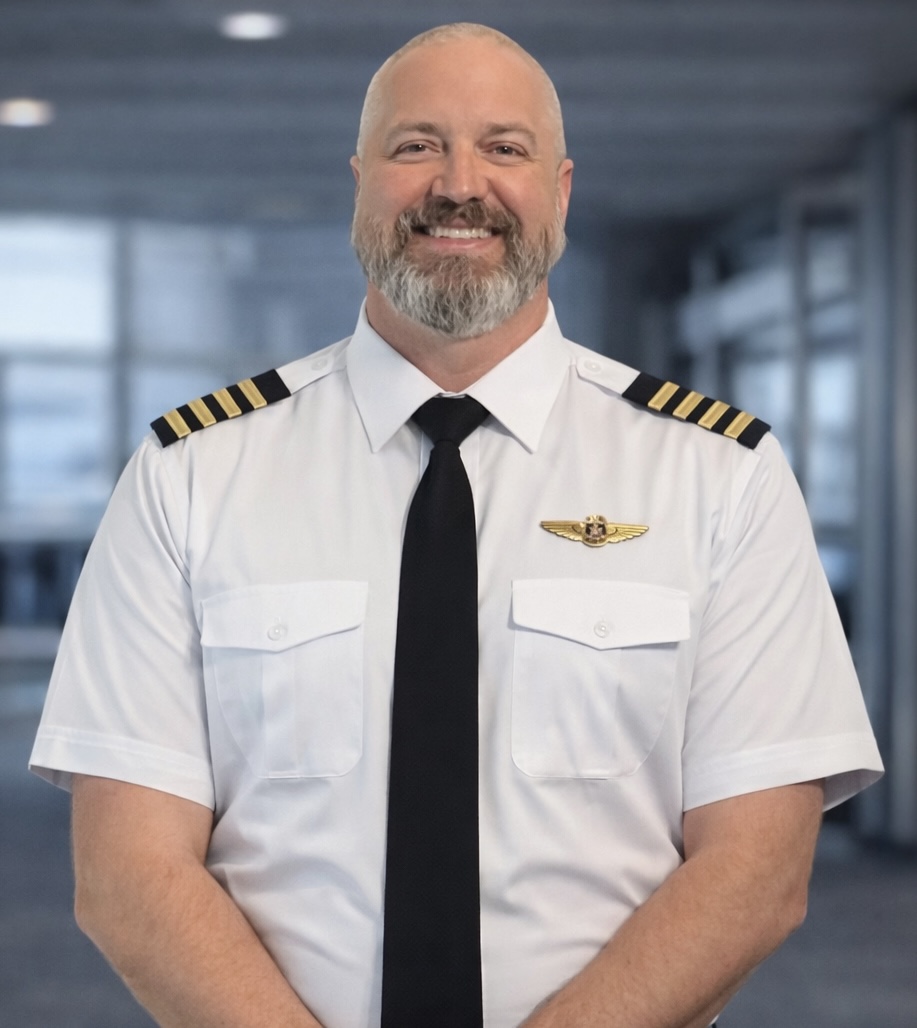
About the Author
Kevin Alvarez
Kevin Alvarez is an ATP-rated Chief Pilot and aviation expert witness with experience in corporate aviation operations, pilot decision-making, FAA compliance, operational risk analysis, and aviation accident investigation. His analysis focuses on the operational and human factors dimensions of aviation accidents, providing attorneys and investigators with technically grounded, operationally accurate expert review.
Full Bio