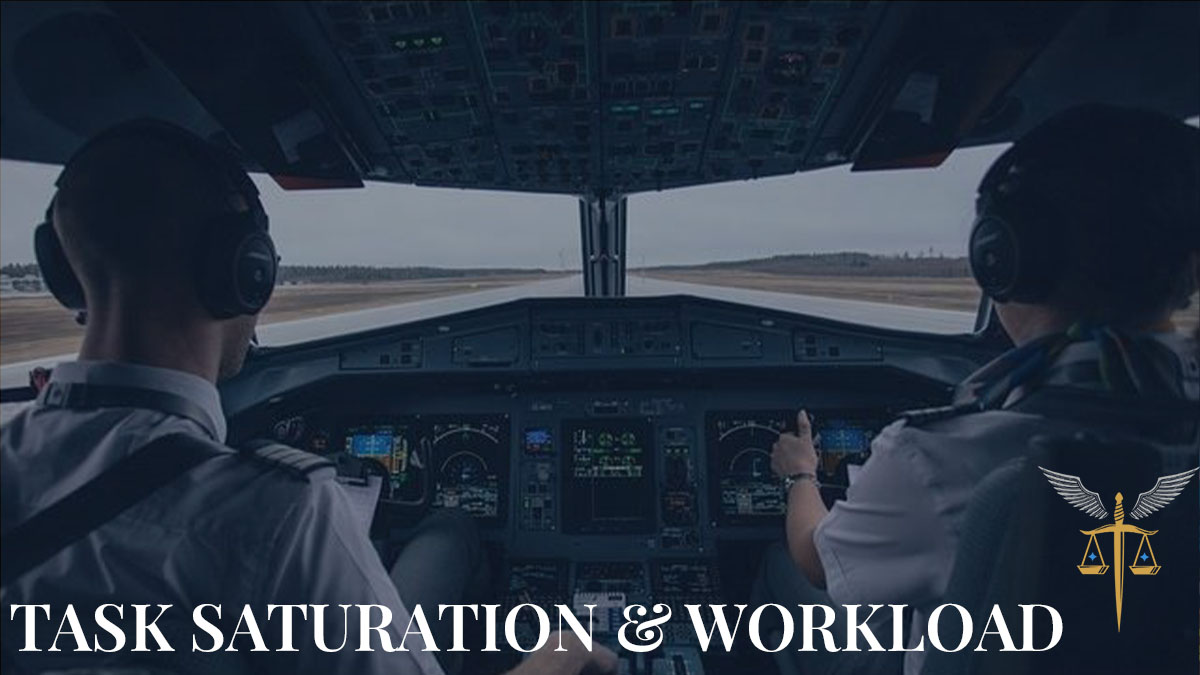

When attorneys evaluate a runway excursion, a late go-around, or a checklist omission, the central question is rarely whether the crew made an error. The more operationally accurate question is this: when did the operation become saturated to the point that sound prioritization, threat recognition, and recovery margins were already compromised?
Task saturation is not a single moment. It is a process: one that builds quietly across multiple phases of flight before producing the visible outcome that ends up in an accident report. For attorneys, investigators, and aviation professionals evaluating liability, understanding how workload accumulates is essential to understanding how accidents happen.
How Workload Builds in Line Operations
Task saturation rarely begins with a single catastrophic event. In real line operations, workload builds in layers. A crew may fall behind the aircraft for reasons that appear manageable in isolation: a runway change, deteriorating weather, an amended clearance, a tailwind component near policy limits, anti-ice use affecting landing distance calculations, or automation inputs that no longer match the intended vertical path.
None of these factors alone necessarily produces an accident. The problem is cumulative loading.
From an operational standpoint, this is where analysis typically begins: not at the runway excursion, not at the unstable approach callout, and not at touchdown. The analysis begins earlier in the sequence, when available margin starts to contract. As complexity rises, pilots do not simply become "busy." Their decision bandwidth narrows. Tasks that normally support situational awareness begin competing with tasks required to keep the aircraft on profile, comply with ATC, and manage automation.
This workload migration has predictable effects. Attention shifts toward the most immediate control problem. Secondary cues are absorbed more slowly or missed entirely. Checklist discipline weakens: not because the crew rejects procedure, but because the procedural rhythm is interrupted by external demands. Automation management becomes less of an aid and more of a task generator. The crew's mental model begins to lag behind the actual aircraft state.
How a Routine Arrival Becomes an Unstable Approach

That is how a seemingly routine arrival evolves into an unstable approach. Airspeed trends require correction. Vertical path deviations increase. Power changes become larger and later. Callouts occur, but their meaning is diluted by the crew's mounting commitment to salvage the arrival. If ATC compression, traffic sequencing, or company schedule pressure is present, the threshold for discontinuing the approach often rises at precisely the moment it should be dropping.
On contaminated or performance-limited runways, this dynamic carries additional weight. A crew managing changing braking action reports, crosswind, a revised landing clearance, or late runway occupancy information may continue an approach that is technically recoverable but operationally fragile. Once the aircraft crosses a certain point in space, time, and energy state, the remaining landing distance may no longer support error tolerance.
What appears externally as a touchdown problem is often the downstream consequence of degraded margin management that began miles earlier in the approach. Understanding how unstable approaches develop operationally is a prerequisite for accurate causation analysis in these events.
The Decision Chain: Small Accommodations, Compounding Consequences
In most task saturation cases, the critical issue is not a single bad decision. It is a sequence of small accommodations, each of which seems reasonable in isolation.
The first accommodation is often procedural. The crew accepts a higher-workload arrival because conditions still appear manageable. Then comes a tactical adjustment: a late descent correction, a speed intervention, an unexpected runway change, or an unplanned re-brief. Next, automation mode selection no longer cleanly supports the intended path: requiring additional monitoring and manual intervention. Checklist flow is interrupted. A required cross-check is delayed. ATC is working the frequency hard.
At each point, the crew typically believes the situation remains recoverable. That belief matters. It is one reason continuation bias is so persistent in approach-and-landing events. The crew is not ignoring risk in a simplistic sense. They are operating inside a progressively compressed decision environment where each new task reduces the capacity to reassess the overall picture.
This is often where assumptions about crew error break down under scrutiny. Investigators and litigants sometimes isolate the final visible choice (failure to go around, long touchdown, omitted checklist item, delayed braking application) as though it arose in a stable decision environment. Operationally, that framing is frequently inaccurate. By the time the last error becomes visible, the crew may already be task-saturated, cognitively narrowed, and managing a chain of compounding demands with diminishing reserve.
The most operationally significant decision points in these events typically include:
- When the approach first ceased to meet stabilized criteria under company or aircraft standards
- Whether the crew had the time and cognitive bandwidth to recognize a deteriorating energy state
- Whether automation mode confusion or excessive FMS management introduced avoidable workload
- Whether checklist interruptions prevented complete landing configuration and performance verification
- Whether ATC sequencing or operational expectations created pressure that discouraged an earlier go-around decision
- Whether runway condition, aircraft weight, wind component, or braking assumptions materially reduced the available stopping margin
Human Factors and Cognitive Narrowing
Task saturation intersects directly with well-documented human factors mechanisms. As cognitive load approaches capacity, attentional resources concentrate on the most demanding immediate task. Peripheral monitoring (the kind that catches a worsening wind trend, a checklist omission, or an energy state drifting outside acceptable bounds) degrades first.
This is not a crew failure in the conventional sense. It is a predictable consequence of exceeding the bandwidth for which normal procedures and training are designed. Human factors analysis in aviation accidents consistently shows that when task demand outpaces available capacity, error rates rise and recovery windows shrink.
The automation environment compounds this in modern glass-cockpit aircraft. Mode awareness, energy management, and FMS sequencing are cognitively demanding even under normal conditions. When a crew is already managing a high-workload environment, automation that requires frequent monitoring, mode intervention, or re-programming becomes a liability rather than an asset. An automation-generated distraction at a critical phase of flight can be the factor that converts a manageable arrival into a sequence the crew can no longer effectively interrupt.
Legal Analysis: What Attorneys Need to Evaluate

For legal professionals, workload-based cases require more than identifying the final procedural noncompliance. The analysis must address whether operational complexity accumulated in a way that predictably degraded crew performance well before the final deviation occurred. That evaluation involves several distinct layers.
- Timeline Reconstruction in Operational Terms: The event timeline must be reconstructed operationally: not merely by transcript or flight data markers in isolation. The question is how many concurrent tasks the crew was managing at each stage, and which of those tasks were aircraft-control critical versus administratively necessary. A late runway change during marginal IMC conditions carries a fundamentally different operational significance than a routine frequency change under clear skies.
- Applicable Standards and Procedural Drift: The applicable standards must be identified and applied in sequence. These typically include stabilized approach criteria, SOP requirements for go-around initiation, checklist completion policy, callout responsibilities, automation use policy, and runway performance procedures. In many cases, the issue is not whether a rule existed, but whether the operation had already drifted outside the margin those rules were designed to protect: and when that drift became operationally significant.
- Causation Evaluated in Sequence: Causation must be evaluated in sequence, not in reverse from the final visible event. A runway excursion may be attributed superficially to excessive landing speed or delayed braking application. From an expert operational perspective, those outcomes may instead be downstream effects of earlier workload-induced instability, incomplete performance review, or delayed recognition that the approach should have been discontinued. Understanding how runway excursions develop operationally is essential context for evaluating whether the terminal event was foreseeable from an earlier point in the approach sequence.
- Human Factors Tied to Specific Operational Demands: General references to distraction or stress are insufficient for expert analysis. The evaluation must identify what specifically drove task loading at each phase: weather updates, an unstable vertical profile, automation mode reversions, radio congestion, checklist interruption, runway contamination concerns, or operational pressure to continue the approach. This specificity is where liability questions often emerge for operators, training departments, and dispatch assumptions.
- Foreseeable Workload vs. Abnormal Overload: One of the more legally significant distinctions in these cases is the line between foreseeable workload and abnormal overload. The legal question is often whether this workload remained within trained and supportable limits, or whether the surrounding conditions produced a predictable erosion of monitoring capacity, decision-making quality, and go-around willingness. Expert operational review adds value that flight data alone cannot provide: flight data documents the unstable approach, but it does not explain why the crew remained committed to it.
Risk Margins and the Point of Structural Vulnerability
Task saturation is not best understood as cockpit busyness. It is a progressive reduction in margin, attention, and evaluative capacity as operational demands outpace available bandwidth. That distinction changes the inquiry from "Why did the crew make the last mistake?" to "When did the operation become structurally vulnerable to that mistake?"
In accident analysis, that is often the more important question. It shifts attention from the final error, which may be a single checklist item or a three-second delay in go-around initiation, to the operational sequence that narrowed the margin to the point where that error became nearly inevitable.
Unstable approaches, runway excursions, delayed go-arounds, and checklist omissions are frequently treated as isolated failures in post-accident analysis and litigation. In real operations, they are more often the final expression of cumulative task loading, narrowing options, and deteriorating threat recognition already in motion well before the event became visible to external observers. Understanding how pilot decision-making failures shape liability in these events provides essential context for accurate causation analysis of task saturation sequences.
Need Aviation Expert Analysis?
Workload-based accident cases require operational expertise that goes beyond reading a flight data readout or a checklist SOP. AeroVerdict provides independent operational analysis and aviation expert witness consulting for attorneys evaluating causation, liability, and pilot decision-making in complex aviation accident cases.
Request an Expert Case Review
About the Author
Kevin Alvarez
Kevin Alvarez is an ATP-rated Chief Pilot and aviation expert witness with experience in corporate aviation operations, pilot decision-making, FAA compliance, and aviation accident analysis. Through AeroVerdict, he provides expert witness and consulting services for attorneys and legal teams.
Full Bio